
Advertising is perhaps one of the most important marketing tools that can be employed by an organisation and there are a great variety of ways organisations can go about delivering their message.
One of the most effective ways of doing so is through the use of endorsers.
A study by Ad Age in 2017 found that 85% of consumers said that celebrity endorsements boosted their confidence in a brand and 15% said they affected their purchasing decisions.
So just how influential can endorsers be in advertising? And what can cause it all to go wrong?
To get a good understanding, it is useful then to look at some of the most (and least) successful adverts of the last few decades to see how likeability has had an impact.

Welcome Home – Walkers & Gary Lineker (1997)
In 1995, Walkers debuted an advert with the endorser Gary Lineker as the main feature, illustrating Lineker’s return back to his hometown of Leicester at the end of his footballing days in Japan.
Following the debut of this advert, Lineker has been the face of Walkers Crisps for over 20 years. His (and the adverts) likeability certainly had something to do with this.
Given that the advert centres around Lineker being presented as an authentic, homegrown talent, consumers are more likely to perceive the endorser as trustworthy and it is clear that trust is of paramount importance to consumers.
One model, put forward by McCracken in the late 80’s offers a good explanation for why this is so important to consumers.
McCracken’s ‘meaning transfer’ model suggests that the meaning developed around a celebrity transfers to the company, brand or product.
In their ‘Welcome Home’ advert, Walkers make use of Lineker’s status in England as a national treasure and so he becomes the focal point over the product itself.
Over the next few decades, Walkers became a staple of the British lunchbox and Lineker can certainly take some of the credit for this success. 50 adverts later, Lineker has sold millions of bags of crisps to the nation which once knew him for his football, and now adores his crisps.
So for Walkers, a likeable endorser launched a long and successful three decades of crisps sales. But how damaging can it be when the endorser is a bad fit for the brand?
Pepsico found this out the hard way in 2017 with their advert: ‘Live for Now’, staring reality star Kendall Jenner.

‘Live for Now’ – Pepsico & Kendall Jenner
Jenner, a high profile celebrity, is seen leaving a modelling shoot to join a crowd of protestors in the street. Jenner is then seen handing the apparent remedy to the protest to a police officer. What was the remedy, you may ask? A thought provoking letter? A well delivered, emotional speech? No. The answer to the problem was instead, a can of Pepsi.
The message is clear: if only someone around the London area in 2011 had thought to buy a Pepsi, they could have saved the tax payers millions of pounds and the city of London from a riot.
The advert was immediately a failure and after only one day of its debut, Pepsi were forced to pull the advert from the internet and apologise on twitter.
The advert was tone deaf and the endorser was a terrible fit, seeming to trivialise serious social and political issues.
Jenner, who appears to join the protest as ‘one of the people’, is a celebrity renowned for being money orientated and this contrasts the message of unity Pepsi are attempting to emulate. What Jenner lacks in trustworthiness is transferred over to the brand and this lead to a PR nightmare for Pepsi.
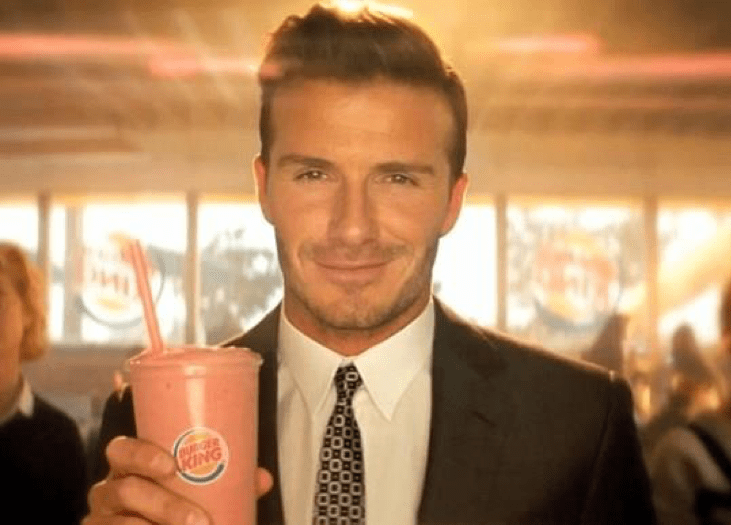
‘Real Fruit Smoothies and Frappes’ – Burger King & David Beckham
The third example of endorser advertising selected is David Beckham’s Burger King Advertisement launching the release of their ‘Real Fruit Smoothies and Frappes’ in 2012.
Burger King demonstrates how endorsers and likeability work hand in hand to create a highly effective advert.
In the advert, Beckham asks for one of Burger King’s ‘real fruit smoothies’ and appears to have both male and female Burger King workers pining over his attractiveness.
Beckham’s smooth talking and charismatic persona are reflected in the presentation of the new Real Fruit Smoothie. This makes for a likeable and successful advert.
Much like with Lineker, Beckham is perceived as a national icon who the public had developed a relationship with over his playing years.
Beckham’s success and adoration as an athlete were transferred over to Burger King’s products. This shows the importance of using likeable, well-suited endorsers in advertisements.
Overall then, endorsers can be instrumental in determining the success of an advert. Their likeability and suitability to the advertising message must be carefully considered. The social media firestorm and PR mess experienced by Pepsico provides evidence for just how damaging it can be for an organisation when the endorser is a poor fit to the brand.
 Matt Jackson's BEMM129 blog