Netflix: A meteoric rise
Netflix is one of the largest and most significant players in the digital economy. According to Fortune.com, its services alone contribute to around 15% of the entire world’s internet bandwidth (Fortune.com, 2018).
But just how did Netflix become the behemoth it is?
Netflix was first founded in 1997 as a website-based movie rental service, allowing customers to rent DVD’s online, receive the DVD’s in the post and then post them back to Netflix. Consistently throughout their growth, Netflix have utilised a subscription-based business model, which has been successful since it’s early days.
This model has made use of digital technologies to beat competitors in the market and become a market leader. The subscription-based business model allowed Netflix to sidestep the unattractive feature of late fees. According to Inc.com, Netflix founder Reed Hastings claimed that he started Netflix because he owed $40 in late fees on the movie Apollo 13 (2019).
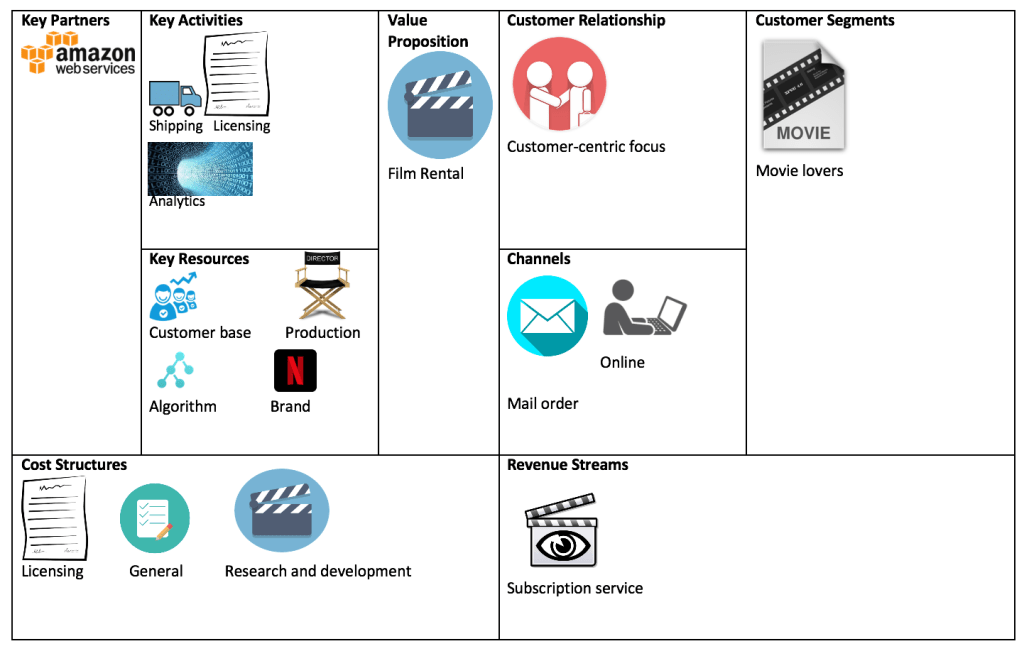
Within this subscription based business model, digital tools such as the Netflix’s website proved to be the key piece to the jigsaw puzzle in delivering products directly to a customers’ door for them to keep for as long as they wanted it.
By February 2007, Netflix had distributed its billionth DVD (Medium.com, 2017). During this time, the core competencies that contributed to its growth were in logistics and distribution. This would all change however as Netflix recognised the power of data and analytics.
In 2006, Netflix opened a crowdsourcing competition called ‘The Netflix Prize’ (Neflixprize.com, 2006) where $1 million was on the line for any individual/group that could create a movie recommendation algorithm 10% more accurate than the one they were currently employing.
By 2009, $1m had been awarded to a team in the US who had helped Netflix improve their ability to connect people to the movies they love. Netflix focused its resources on being a data-driven company, making great use of AI and machine learning to continuously learn more about its customers to more accurately recommend films they may love.
Machine learning is frequently regarded as one of the most useful features of AI for businesses, as AI can allow firms to ‘know what your customers need before they do’ (Loop54.com).
SAS Insights, an analytics and data science company go on to say that machine learning is the best way for an organisation to identify profitable opportunities and avoid unknown risks (SAS.com, 2020).
The disruption caused by Netflix’s accurate recommendation system and efficient logistics arguably played a large role in displacing the need for Brick and Mortar stores. Hastings and Randolph brought customer-centricity to the forefront of their business model.
The need for customers to peruse the aisles and wait in a line to pay for their Saturday night movie were replaced by a service that matched customers with movies they would enjoy, delivered directly to their door.
By summer 2010, Blockbuster, a large player in the DVD/Film Rental industry filed for bankruptcy and put itself up for sale for ‘the embarrassing starting price of $290 million’ (BusinessInsider.com). An infographic from Online MBA Programs elucidates the role that Netflix played in the downfall of Blockbuster
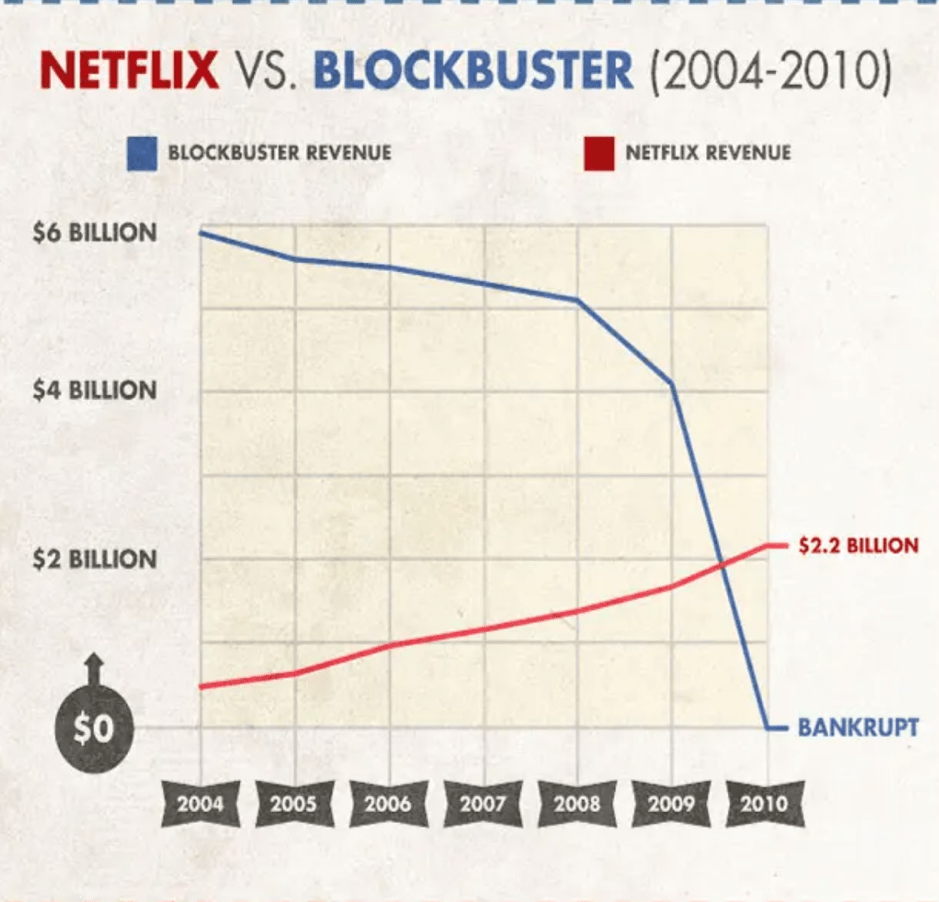
From: Adweek.com, 2011
Overall, this acts as interesting evidence supporting the importance for businesses to possess a dynamic business model that changes with the rapidly changing consumption habits brought about by digital technologies.
Netflix continuously innovates to make use of new technologies and this is a key aspect of its business model. Netflix digitised the products it once offered off-line in 2007 by launching their video streaming service.
Netflix now has 167 million subscribers worldwide and this dominance was fuelled by the fact that it was the first mover in the over-the-top video subscriptions service (BusinessInsider.com, 2020).
At the time of its video subscription launch in 2007, Netflix possessed a mamouth 91% global market share of over-the-top video subscriptions.
Their founder, Hastings, recognised the potential for for streaming services in 2011: “Our core strategy is to grow our steaming subscription business domestically and globally. We are continuously improving the customer experience, with a focus on expanding our streaming content, enhancing our user interface and extending our streaming service to even more internet connected devices”.
Evidently, throughout their method of continuous innovation, the customer is always at the centre for Netflix and this has been a huge contributor in the success of their organisation.
Whilst many aspects of the digital business model have been so important for Netflix, their customer-centric approach to all activities has perhaps been the key driver to the success of the organisation.
A ‘customer comes first’ attitude has been so key and this must be recognised when evaluating the success of one of the most successful organisations to have ever existed.
References
Adweek.com (2020): Netflix destroyed blockbuster’ Retrieved on 3rd Mar 2020 from: https://www.adweek.com/digital/netflix-destroyed-blockbuster-infographic/?utm_source=feedburner&utm_medium=feed&utm_campaign=Feed%3A%20socialtimes%20%28SocialTimes.com%29&utm_content=FeedBurner
Adweek.com (2010): ‘Did web video bankrupt blockbuster’ Retrieved on 2nd Mar 2020 from https://www.adweek.com/digital/did-web-video-bankrupt-blockbuster/
BusinessInsider.com (2020): How Netflix Bankrupted and destroyed Blockbuster’ Retrieved on 3rd Mar 2020 from https://www.businessinsider.com/how-netflix-bankrupted-and-destroyed-blockbuster-infographic-2011-3?r=US&IR=T
Fortune.com (2018): ‘Netflix Consumes 15% of the World’s Internet Bandwidth’ Accessed on 2nd Mar 2020 from https://fortune.com/2018/10/02/netflix-consumes-15-percent-of-global-internet-bandwidth/
Inc.com (2018): ‘People think Netflix killed Blockbuster. Now a New Report says these 7 other things mattered more’. Retrieved on 4th Mar 2020 from https://www.inc.com/bill-murphy-jr/people-think-netflix-killed-blockbuster-now-a-brand-new-report-says-these-7-other-things-mattered-more.html
Medium.com (2020): ‘Netflix, a case of transformation for the digital future’. Retrieved on 3rd Mar 2020 from: https://medium.com/@nvenkatraman/netflix-a-case-of-transformation-for-the-digital-future-4ef612c8d8b
NetflixPrize.com (2006): ‘Netflix Prize’ Accessed on 3rd Mar 2020 from: https://www.netflixprize.com/
SAS.com (2020): ‘Machine learning – What it is and why it matters’ Accessed on 1st Mar 2020 from https://www.sas.com/en_gb/insights/analytics/machine-learning.html
Follow My Blog
Get new content delivered directly to your inbox.
 Matt Jackson's BEMM129 blog