Featured

How an endorser can make (or break) an advert

Advertising is perhaps one of the most important marketing tools that can be employed by an organisation and there are a great variety of ways organisations can go about delivering their message.

One of the most effective ways of doing so is through the use of endorsers.

A study by Ad Age in 2017 found that 85% of consumers said that celebrity endorsements boosted their confidence in a brand and 15% said they affected their purchasing decisions.

So just how influential can endorsers be in advertising? And what can cause it all to go wrong?

To get a good understanding, it is useful then to look at some of the most (and least) successful adverts of the last few decades to see how likeability has had an impact.

Welcome Home – Walkers & Gary Lineker (1997)

In 1995, Walkers debuted an advert with the endorser Gary Lineker as the main feature, illustrating Lineker’s return back to his hometown of Leicester at the end of his footballing days in Japan.

Following the debut of this advert, Lineker has been the face of Walkers Crisps for over 20 years. His (and the adverts) likeability certainly had something to do with this.

Given that the advert centres around Lineker being presented as an authentic, homegrown talent, consumers are more likely to perceive the endorser as trustworthy and it is clear that trust is of paramount importance to consumers.

One model, put forward by McCracken in the late 80’s offers a good explanation for why this is so important to consumers.

McCracken’s ‘meaning transfer’ model suggests that the meaning developed around a celebrity transfers to the company, brand or product.

In their ‘Welcome Home’ advert, Walkers make use of Lineker’s status in England as a national treasure and so he becomes the focal point over the product itself.

Over the next few decades, Walkers became a staple of the British lunchbox and Lineker can certainly take some of the credit for this success. 50 adverts later, Lineker has sold millions of bags of crisps to the nation which once knew him for his football, and now adores his crisps.

So for Walkers, a likeable endorser launched a long and successful three decades of crisps sales. But how damaging can it be when the endorser is a bad fit for the brand?

Pepsico found this out the hard way in 2017 with their advert: ‘Live for Now’, staring reality star Kendall Jenner.

‘Live for Now’ – Pepsico & Kendall Jenner

Jenner, a high profile celebrity, is seen leaving a modelling shoot to join a crowd of protestors in the street. Jenner is then seen handing the apparent remedy to the protest to a police officer. What was the remedy, you may ask? A thought provoking letter? A well delivered, emotional speech? No. The answer to the problem was instead, a can of Pepsi.

The message is clear: if only someone around the London area in 2011 had thought to buy a Pepsi, they could have saved the tax payers millions of pounds and the city of London from a riot.

The advert was immediately a failure and after only one day of its debut, Pepsi were forced to pull the advert from the internet and apologise on twitter.

The advert was tone deaf and the endorser was a terrible fit, seeming to trivialise serious social and political issues.

Jenner, who appears to join the protest as ‘one of the people’, is a celebrity renowned for being money orientated and this contrasts the message of unity Pepsi are attempting to emulate. What Jenner lacks in trustworthiness is transferred over to the brand and this lead to a PR nightmare for Pepsi.

‘Real Fruit Smoothies and Frappes’ – Burger King & David Beckham

The third example of endorser advertising selected is David Beckham’s Burger King Advertisement launching the release of their ‘Real Fruit Smoothies and Frappes’ in 2012.

Burger King demonstrates how endorsers and likeability work hand in hand to create a highly effective advert.

In the advert, Beckham asks for one of Burger King’s ‘real fruit smoothies’ and appears to have both male and female Burger King workers pining over his attractiveness.

Beckham’s smooth talking and charismatic persona are reflected in the presentation of the new Real Fruit Smoothie. This makes for a likeable and successful advert.

Much like with Lineker, Beckham is perceived as a national icon who the public had developed a relationship with over his playing years.

Beckham’s success and adoration as an athlete were transferred over to Burger King’s products. This shows the importance of using likeable, well-suited endorsers in advertisements.

Overall then, endorsers can be instrumental in determining the success of an advert. Their likeability and suitability to the advertising message must be carefully considered. The social media firestorm and PR mess experienced by Pepsico provides evidence for just how damaging it can be for an organisation when the endorser is a poor fit to the brand.

Featured

Have the changes to Refereeing gone too VAR?

Football and the digital economy are two concepts which at first glance do not appear to sit hand in hand. Football, and more specifically football refereeing, depends on the presence of soft skills such as communication, judgement, team-work and decision making (Doyle, 2020). You would therefore be forgiven if you were under the impression that refereeing has been relatively untouched by the digital economy.

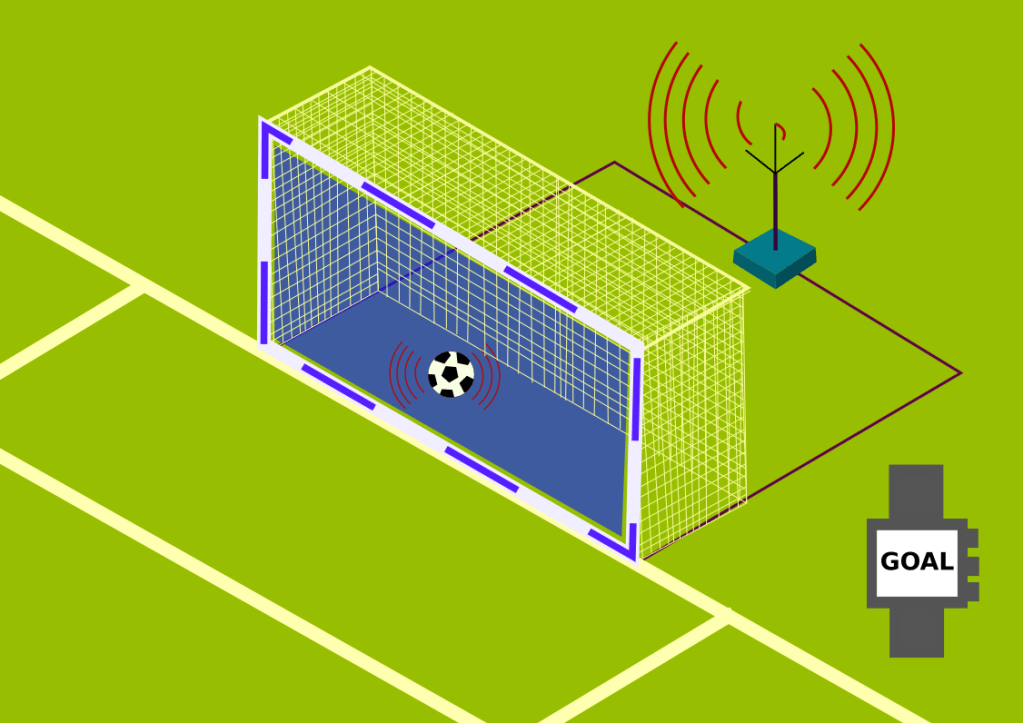
Traditionally, programming AI to think beyond simple and routinised decision making and subsequently implementing this at a real time level has been difficult. However, technology has changed the job role of a football referee in many ways, with the implementation of goal-line technology in 2012, the introduction of communication systems amongst referees in 2006 and the introduction of Video Assistant Referee’s (VAR) in 2018 being three of the most recent examples. The implementation of this technology, particularly the latter, has been met with resistance. Thus, it is interesting to consider: in what ways has technology changed the job of those holding the whistle (both on and off the pitch)? And how much further can technology go in replacing human judgement in the game loved by so many?

Technology has improved the job role for referees in a number of ways. The new communication systems have (obviously) improved the ability of the match officials to work and communicate as a team. Goal line technology and VAR have similarly improved the accuracy of decisions and so have worked to reduce human error – arguably benefitting referees, players and fans alike.

 On the surface, this acts as good evidence for the way that technology and AI are increasingly encroaching more aspects of our lives. Contrary to popular assumptions, AI is not just good at routinised behaviour such as acting as part of an assembly line. Now, it assists judgment and the decisions made in many industries, including sport. This is supported by Brynjolfsson and McAfee (2014) in their book: ‘The Second Machine Age: Work, Progress and Prosperity in a Time of Brilliant Technologies’ who suggest that despite common belief, developments in technology have improved the ability of Artificial Intelligence (AI) to compute high level reasoning with very little computation. AI may therefore progressively play a role in supporting occupations where decision making based on learned rules is key to the job role – such as refereeing.

By improving the accuracy of decisions, technology has taken some pressure off of referees in what is an extremely high-pressure environment. After THAT game against Germany in the world cup of 2010 the referee and his two linesmen were under police protection as they left the match following the controversially disallowed goal which was (clearly) over the line. The heartbreaking moment can be seen above.

With the introduction of Goal-line-technology, this level of human-error has been eradicated from the game. Decisions which were once subjective and based purely on human judgement have become objective through the introduction of technology. This proves so important for referee’s, where the pressure is so great that ‘big errors often produce an emotional fallout that hurts a lot’ (Sutcliffe, 2019). Technology has therefore acted as a lifeline for referees where the high levels of scrutiny experienced after a wrong decision can have huge impacts mentally. One only needs to complete a brief search on Twitter and the evidence for why is outstanding:

Sickening abuse sent to ex-premier league referee Bobby Madley
https://www.mirror.co.uk/sport/football/news/bobby-madley-reveals-sickening-abuse-14212614

The rise in social media and digital technologies brings new meaning to the phrase ‘everyone’s a critic’. Referees are experiencing higher levels of scrutiny (and abuse) than ever before as a result of social media and this is something that is certainly having an impact on the profession. Ex premier league referee Madley has frequently spoken out against the abuse received by refs on social media.

Sickening abuse sent to ex-premier league referee Bobby Madley
https://www.mirror.co.uk/sport/football/news/bobby-madley-reveals-sickening-abuse-14212614

 The digital world empowers fans and places referees under higher levels of scrutiny than ever before. Ironically, the implementation of more digital technology could be the answer to protecting referees – where abuse is now aimed at technologies such as VAR rather than falling on the referees shoulders.

Undoubtedly, technology and the digital economy will continue to have great impacts on refereeing as a job role. Much like it is impossible to predict what cars will look like in 30 year’s time, or accurately forecast the mobile phones of tomorrow, it is difficult to make assumptions on how specifically technology will further change the game. However, there is an argument that technology such as VAR should be taken back out of the game to reshape the referees job for the better.

This brings forward the question: Can technology ever replace human judgement? If, after examining the implementation of VAR, the answer is no, then perhaps refereeing needs to be taken back to basics: a reinvention of the job where the digital economy has far less impact. I would argue that the humanistic refereeing errors are a suitable price for fans to pay to maintain the thrill of the game.

Perhaps then, the digital economy has changed the game too far – bringing with it inhuman levels of objective judgement for decisions which are subjective in their nature. In the future, refereeing may be further changed by the digital economy, with AI offering an abundance of solutions. However, can technology ever replace human judgement… and has technology in football gone VAR enough?

References:

Byrnjolfsson, E. and McAfee, A. (2014): ‘The Second Machine Age: Work, Progress and Prosperity in a Time of Brilliant Technologies’ 

Doyle, A. (2020): ‘What are Soft Skills?’. Accessed on 10th Feb 2020 from: https://www.thebalancecareers.com/what-are-soft-skills-2060852

Sutcliff, S (2019): ‘Mistakes, abuse & VAR: What are the pressures on a premier league ref?’ Accessed on 12th Feb 2020 from: https://www.bbc.co.uk/sport/football/47690634

Department for Business, Energy and Industrial Strategy (2019): ‘Business Basics: Attitudes to Adoption’ (PDF) Accessed on 11th Feb from https://assets.publishing.service.gov.uk/government/uploads/system/uploads/attachment_data/file/838473/attitudes-to-adoption.pdf

My journey to becoming a ‘third space thinker’

‘Tell me and I forget it, teach me and I may remember it, involve me and I learn’ Benjamin Franklyn

What has this module taught me?

Throughout the module, I have learned a great deal from reading, reflecting and commenting on the work of my peers. Being very involved in the teaching and learning has been of great use as it allows me to share in the wealth of knowledge offered by the future leaders on this course.

It was useful to hear of Mark’s experiences of football coaching as this was an area where I had not expected technology to have much impact.
Hearing personal perspectives has given me a great appreciation for the way that culture and background impact the outlook different people have on issues. This is one aspect of joint learning that is particularly useful. Swing and Peterson (1982) support this, suggesting that collaborative learning encourages more diversity understanding amongst those involved.

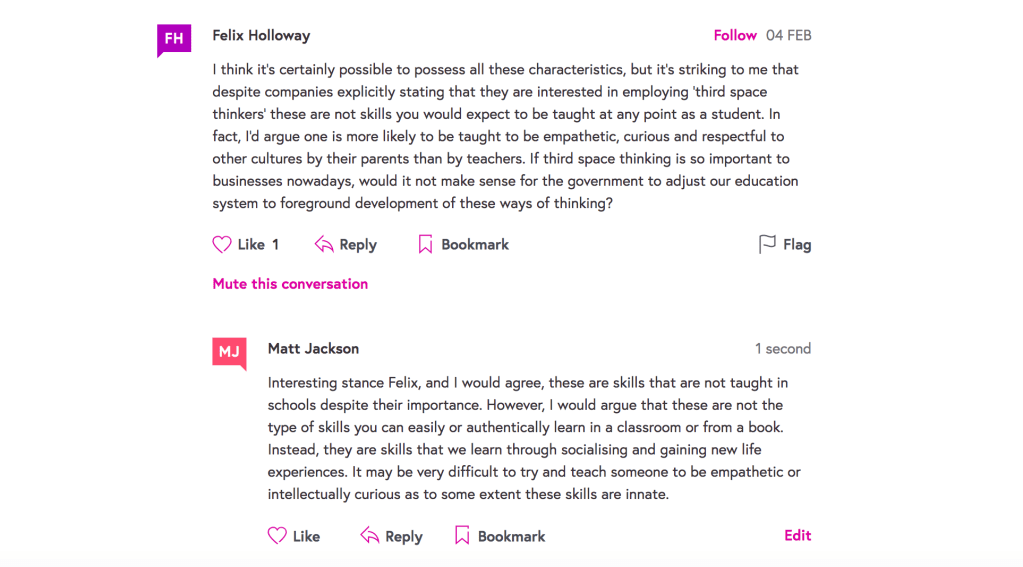
This skill will prove particularly important for me as workplaces are increasingly diverse and so it is great to have a good understanding of other ways of thinking. Now, when reading through articles or blog posts in general, I feel myself looking more analytically and curiously at content, which has proven to improve memory and learning.  

Learning to be a better learner

“I have no special talents. I am only passionately curious.” – Albert Einstein

Being able to compare different perspectives on the same issue is a skill I have developed to help me become a better learner. When comparing Roy’s blog on Just Eat with Mark’s on Airbnb, I identified a theme in the problems faced by platform business models concerning regulation. By thinking synoptically, I can now look thematically at problems to help identify solutions.

Key Learning point – Striving to become a third space thinker

This module has improved my ability to be a third space thinker, a skill which is in demand but undersupplied in the employment market (Weishaupt, 2017). Ernest J. Wilson summarises what this means in the video below.

Third space thinking is an invaluable attribute that will allow me to ask different kinds of questions, offer unique solutions whilst ‘creating different kinds of work units with different incentives which are different from what you’d find in a traditional business unit’ (Weishaupt, 2017).

As a third space thinker, this module has afforded me with a number of unique skills and attributes that will be invaluable to me going forward and for that I am greatly thankful!

References:

Swing, S.R. & Peterson, P.L. (1982). The relationship of student ability and small group interaction to student achievement. American Educational Research Journal, 19 (2), pp. 259-274.

Weishaupt, P. (2017) :“’Third space thinkers” required to compete in the digital economy’

Introduce Yourself (Example Post)

This is an example post, originally published as part of Blogging University. Enroll in one of our ten programs, and start your blog right.

You’re going to publish a post today. Don’t worry about how your blog looks. Don’t worry if you haven’t given it a name yet, or you’re feeling overwhelmed. Just click the “New Post” button, and tell us why you’re here.

Why do this?

  • Because it gives new readers context. What are you about? Why should they read your blog?
  • Because it will help you focus you own ideas about your blog and what you’d like to do with it.

The post can be short or long, a personal intro to your life or a bloggy mission statement, a manifesto for the future or a simple outline of your the types of things you hope to publish.

To help you get started, here are a few questions:

  • Why are you blogging publicly, rather than keeping a personal journal?
  • What topics do you think you’ll write about?
  • Who would you love to connect with via your blog?
  • If you blog successfully throughout the next year, what would you hope to have accomplished?

You’re not locked into any of this; one of the wonderful things about blogs is how they constantly evolve as we learn, grow, and interact with one another — but it’s good to know where and why you started, and articulating your goals may just give you a few other post ideas.

Can’t think how to get started? Just write the first thing that pops into your head. Anne Lamott, author of a book on writing we love, says that you need to give yourself permission to write a “crappy first draft”. Anne makes a great point — just start writing, and worry about editing it later.

When you’re ready to publish, give your post three to five tags that describe your blog’s focus — writing, photography, fiction, parenting, food, cars, movies, sports, whatever. These tags will help others who care about your topics find you in the Reader. Make sure one of the tags is “zerotohero,” so other new bloggers can find you, too.

Design a site like this with WordPress.com
Get started